

January 21, 2026


Anyone can use AI or pay someone to set up their Shopify store nowadays, but not everyone can drive the right traffic and convert them into actual sales.
We've seen this again and again with merchants who are new to Shopify or new to running pre-orders. They're obsessed with getting the technical setup perfect - spending days deciding what and which apps to use, tweaking the checkout flow, editing each single word on their product pages, but they haven't put enough thought into the most important question:
How will people actually know you exist, and that you're running pre-orders?
To date, we've worked with more than a thousand Shopify merchants on their pre-order campaigns. The biggest issue isn't choosing the right product to sell. It's the lack of distribution and differentiation.

In this article, I'm walking you through three actual merchant conversations, what we told them about marketing their pre-orders, and what you need to do before your product launch to actually get sales.
Prefer video? You can watch our video version of this article below:
Earlier this year, a fashion brand founder in New York reached out about setting up pre-orders. (Let's call her Maria.)
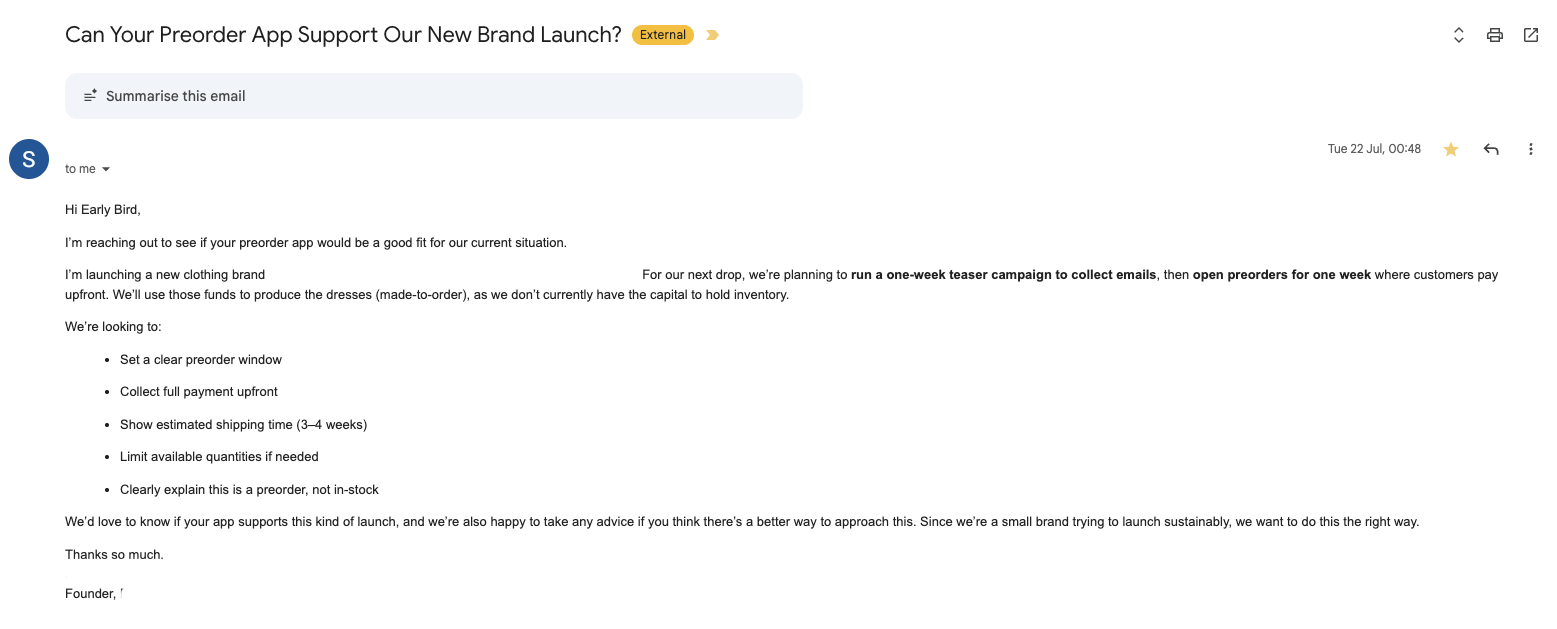
They'd done everything right technically. Beautiful product photos, got all their preorder policy pages done up, have already set clear shipping timeline expectations with customers etc.
But they got zero sales for their first launch.
It wasn't because their designs weren't good. It wasn't because they didn't have a marketing budget. It wasn't because their website looked terrible either. It was simply because no one knew the launch was happening.
"Hey Josiah, I've done all these things already - I've got really great dress designs, we made 100 of them, and we've set up a beautiful website. We tried posting organically because we don't have a huge budget for ads yet since our cash flow is tied up in inventory. Can you look at my pre-order setup and advise if we should we do a waitlist first, or go straight to pre-orders for our second launch?"
I advised Maria to start capturing waitlist sign-ups immediately.
In a perfect world, she'd sell pre-orders to secure cash flow earlier - to get money sooner to invest in marketing, photoshoots, etc. But realistically, as a new brand starting from scratch, she has zero credibility. Zero conversion history. It's going to be a hard sell.
Capturing waitlist signups first creates a lower barrier to entry. But even then, Maria would need 5,000+ email signups to potentially get 100 sales. That's a 2% estimated conversion rate from waitlist to pre-orders - typical for new brands with no social proof.
For established brands selling products with strong demand, we see 10-20% waitlist to pre-order conversion rates. But that's after building trust.
Your brand and product's positioning matters more than your pre-order discount.
Too many merchants jump straight to choosing marketing channels without figuring out their positioning first. This is actually a SaaS Product Marketing concept that's rarely mentioned in eCommerce.
Instead of trying to target everyone (which means you'll appeal to no one), start narrow. Decide:
Otherwise, there are too many competitors out there. Your marketing (both organic and paid) will sound generic and you won't stand out.
Example 1: Surfboards
We had a Shopify merchant selling surf gear with the tagline "surfboards for surfers, made by surfers." Super common, right? Every startup loves this cliché.
We had another merchant also selling surf gear who targeted parents buying their kid's first surfboard. Immediately you can tell it's much easier for the second brand to know what content to create, which keywords to target, and what their marketing channels should be.
Example 2: Lab-grown Diamonds
Separate to our Shopify apps, I had a consulting client selling lab-grown jewellery, which is an incredibly competitive category. Ridiculous ad bidding costs on Google, high CPMs on Meta.
Instead of going for typical keywords, she positioned her products as "jewellery for your life journey". From dating to engagement, to wedding to family heirloom. That's the purpose. For use cases, she'd position it as a gift for a daughter's 18th birthday, wedding anniversaries, a sister's post-natal gift, or simply stacking jewellery for rich people.
Same products from the same supplier, different positioning. That's how she stood out from the incrediblt competitive category.
Once you figure this out (even as a hypothesis), your marketing becomes much more effective because now you know exactly who you're speaking to and creating content for.

Instead of leading with the common "Get 10% off if you pre-order" or "Pre-order today and get 20% off" offers, try position it as a reservation. E.g. "Reserve your dress before the launch." Make it feel exclusive. Give people a reason to take action rather than cheapening your brand's value.
And pair this with your founder story, because it's your biggest differentiator from competitors. Why these dresses? What makes them different? Who are they for? Show potential customers you have strong conviction about what you're selling, not just trying to make easy money.
This way competitors can't easily replicate it like they do with your products.
This one's a perfect example of having a good product, but zero distribution.

A 3D artist in Austria (let's call him Gareth) was making beautiful printed vases. He found me on Reddit and reached out via DM. He'd already bought 24 glass inserts. People were telling him he should sell these on his own Shopify store, not just as a hobby.
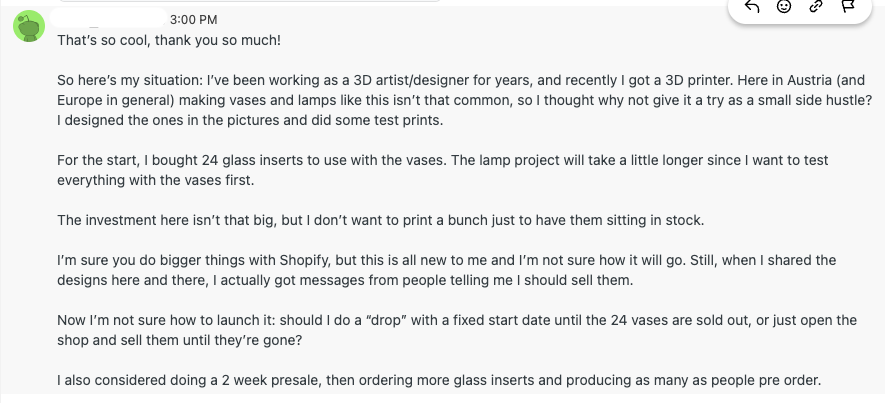
Exciting, right? People encouraging you to take the leap and do your own thing.
But there are two classic mistakes here that many new merchants make:
The goal is to get pre-orders. Get sales. Get customers to pay with money. Even if it's not a full payment upfront, you should at least try capture a partial deposit. It's still a commitment. Then the third-best option is an email signup.
Verbal interest means nothing because talk is cheap.
At any given time, your customers are split into two groups:
It doesn't matter where you promote your products, online or offline. As long as you're consistently showing to the right people. You want to win the battle in their mind of deciding which product to buy before they even need to make that decision.
When Gareth asked me about setting up pre-orders, I didn't talk about the technical setup at all. Because you can have the best product and the best pre-order setup, but it's nothing without distribution.
"How will people know your products exist?"
"Where else can you sell besides your Shopify store? Etsy? Local cafes? Gift shops? Home decor stores? Where are your ideal customers?"
This is the distribution problem nobody talks about. Everyone on social media talks about running ads and conversion rate optimization. Tweaking product pages, optimizing checkout flows etc.
But your main constraint isn't conversion rate. The step before that is driving the right traffic in volume. It's people knowing you even exist.
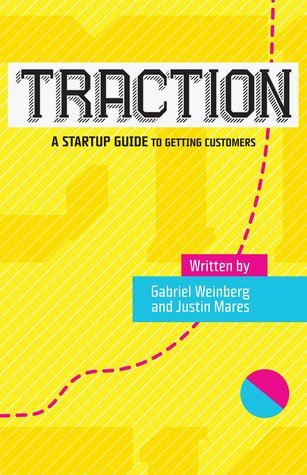
Look up the book "Traction" by Gabriel Weinberg. It walks you through 19 potential customer acquisition channels, like:
For Gareth specifically, Etsy could work well for online reach, while local gift shops and design studios could help build his offline presence. And he could explore partnerships with interior designers who want special products for clients.
That's distribution.
Need help setting up your pre-orders for a product launch? Check out our Shopify pre-order campaign planning guide or try Early Bird for free.
This one's different because Grace (her real name) already had an audience following built from her consulting services.
She'd been working as a nutritionist, with a solid Instagram following and an email list of her past clients. Now she's ready to launch her first physical products - prenatal supplements.
She already understood the customer mindset I mentioned earlier (ready to buy vs. not ready yet), so her main question was: "How far in advance should I warm up my audience? Is 4 weeks enough?"

"It's never too early to start building your owned audience."
Whether you're a new or established brand, it's never too early to do this. Because when you run ads, it's a rented audience. Once you stop paying for ads, there's no way to reach these people anymore.
Even with organic social, the algorithm is always changing. There's no guarantee your content will be seen by the same followers next week.
Waitlist sign-ups allow you to gauge interest AND grow your mailing list simultaneously. Keep in mind that not all back-in-stock widgets will help you capture marketing consent (like Early Bird does), so make sure you check for this functionality.


The goal here isn't just collecting emails. The goal is staying top of mind so when people are ready to buy, you're the first brand (or at least one of the brands) that they think of.
There's also an additional benefit: Grace won't have to heavily rely on ads when it's time to run pre-orders. She has a mailing list she can email for free with much higher, guaranteed organic reach.
Grace was launching supplements, categorised as FMCG (Fast Moving Consumer Goods). This adds another layer of complexity. For FMCG products, you might not want to take customers' payments too early for two reasons:
So instead, I told Grace to:
I also told her something most marketing gurus won't tell you:
Ads should supplement your growth strategy, not spearhead it.
Before running our Shopify apps, I worked on both agency-side and in-house for brands, managing million-dollar ad budgets myself. My entire early career was built on ads. But I've moved away from it because too many brands and startups use "test and learn" as an excuse when running ads, hoping to "buy" product-market fit - when they haven't even worked out fundamentals like unit economics, positioning, and pricing. They're just burning cash.

Grace already had an existing audience that trusted her as a nutritionist, so she should lean into it. Turn that social media following into her owned audience. Diversify her distribution and marketing channels.
Then she can promote her best organic content with ads, rather than purely running cold traffic campaigns hoping to find customers as a new brand. Get people sharing and talking about her products without prompting or paying them. This is what we called "earned audience".
Let me be direct about something most Shopify advice won't tell you:
Even if you're covering your daily ad spend with one sale (people love talking about ROAS and ROI), you're still just renting an audience. The moment you stop paying for ads, your distribution will stop. You have no way to reach your audience anymore.
Start with your owned audience:
When people say "let me know when you restock," don't just take their word for it. Try get them to sign up with their email, because only then, that's the real expression of interest and a leading indicator. Of course, even better if you can capture a commitment to buy. Pre-orders and sales are lagging indicators, but that's what reflects actual demand.
Whether you're an established brand or just starting out, start building your owned audience now. Not when your product is "ready."
Maria (the NYC dress brand) should have been building her email list months before reaching out to me. Gareth (the 3D printed vase maker) should have been documenting his 3D printing experiments and capturing emails from interested followers from the get go.
Grace was already doing this as a nutritionist, which is why her launch had a much better chance of success.
This might sound uncomfortable for introverted founders (including myself - you probably can't tell in the video above that I'm an introvert because I get energized talking about marketing), but don't be shy about sharing your journey.
You'd be surprised how many people want to support someone building a business. Especially if you're young, or just starting out, and have strong conviction for something your target customers can resonate with.
There are so many content creators sharing their journeys on social media these days. I'm sure you'll find inspiration easily!
Yes, Shopify is your online store. But distribution is about sharing something amongst a number of people - not just digital ads and social media.
Where else can Gareth sell? Etsy? Local gift shops? Interior design studios?
Decide who your potential customers are first, then look at the 19 Traction Channels and decide which one to bet on first. Not gonna lie - for early startups and new brands, it can be a gamble because you're still figuring things out.
Where else can Grace distribute her prenatal supplements? Upselling with her nutrition consultancy services? Partnerships with obstetricians? Local parenting groups? That's distribution too, and it has nothing to do with online channels.
Your product and positioning might be differentiated now. But it's a copycat economy nowadays. Copycats will show up.
Eventually it becomes about who can put their product in front of the most relevant people, most cost-efficiently, and acquire at the lowest cost.
That's not the same as "who spends the most on ads." It's about being where your customers already are, online and offline.
Before I wrap up, I'm going to be honest that I don't know whether these three Shopify merchants fully implemented what I suggested them.
I spent time on calls with each of them giving tailored advice. I did my part, and it's up to them to take action.
From my experience, most new merchants don't. I never hear back again from most of the merchants I've helped.
Because the technical setup for Shopify pre-orders through our app only takes 10-15 minutes (depending on your theme, of course). But my advice on how to actually get preorders and sales - i.e. working out the fundamentals, thinking about distribution, building an email list, building trust. That takes weeks or months of daily grinding.
The advice in this blog article sounds straightforward, but the execution is hard. I've done the same for our Shopify apps, and I can tell you it's not easy.
It requires:

It's so much easier to install a Shopify pre-order app and tell yourself that's the solution. (This applies to any other Shopify aspects as well.) But the merchants who actually manage to sell out their pre-orders are the ones who get started on their marketing way before their launch.
If you're planning a product launch and want some help with your pre-order campaign setup (or guidance on marketing your pre-orders), you can connect with me on LinkedIn or get in touch with us at support@shopside.com.au. I read and respond to everything!


